

Herbal Tea Ingredients: What Whole Botanicals Mean
Start with the plant list when shopping for wellness tea ingredients. Rose petals, mint leaves, dried fruit and cut roots may all appear in a botanical infusion. You can sometimes recognize those pieces in a sachet, but their appearance won't tell you how the plants were grown, whether they were tested or exactly how the cup will taste.
Choosing a caffeine-free afternoon drink, or a gift for someone who likes floral tea? Compare the full ingredient list with the flavor description. Visible pieces help identify the ingredients; they do not certify quality.
What “whole botanicals” means in a tea blend
“Whole botanicals” usually means you can recognize the plant material. A flower may retain its petals, while a root or peel may be cut to fit in a sachet. Cut pieces can still be identifiable. Size alone does not guarantee a better cup, and an opaque sachet offers no view at all.
If you can see inside, you may spot a leaf, fruit or petal. That glimpse tells you nothing definite about origin, purity, growing practices, freshness or exact quantities. Dried pieces may also look quite different from the fresh plant.
Even a clear product photo leaves questions. A label that names each botanical and its plant part helps when the pieces are too small to identify by sight.
Flowers, leaves, roots and fruit: what each brings
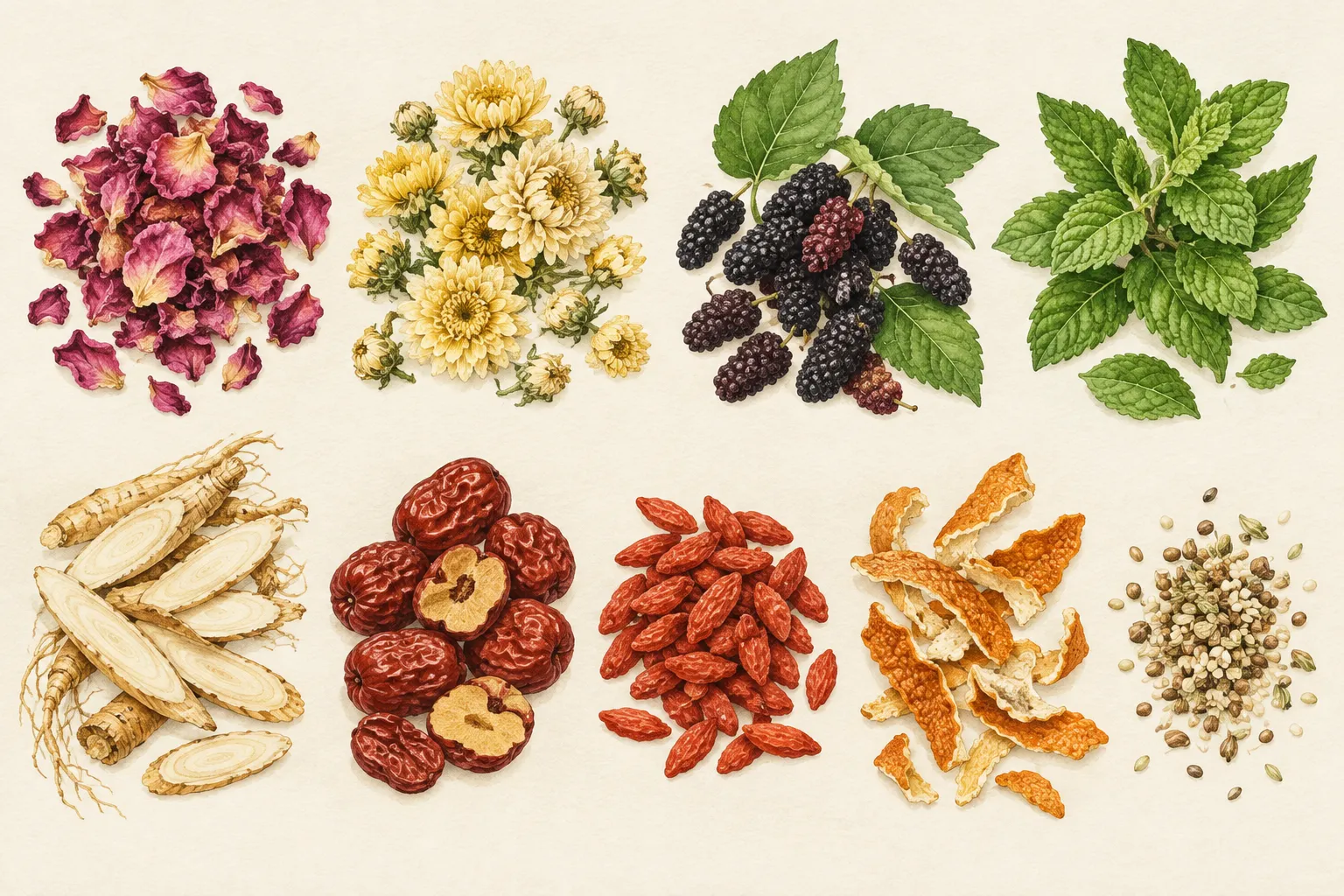
The plant part can hint at flavor, but what you steep it with changes the cup.
Plant part |
Examples in botanical blends |
What to expect in a blend |
|---|---|---|
Flowers |
Rose, chrysanthemum |
Floral notes, from soft rose to lighter floral aromas |
Leaves |
Peppermint, mulberry leaf, lotus leaf |
Fresh mint or a greener, herbal direction |
Roots and rhizomes |
Cultivated ginseng, licorice root, polygonatum rhizome |
An earthy or rounded counterpoint to brighter ingredients |
Fruit |
Longan, jujube (red date), goji berry, hawthorn, dark plum |
Mellow sweetness, deeper fruit character or tartness |
Seeds and peel |
Cassia seed, tangerine peel |
A toasted-herbal note or light citrus lift |
Rose with longan and jujube suggests a softer cup than hawthorn with dark plum and tangerine peel. You still need the full blend and its brewing directions to get a sense of how strong either cup may be.
An herbal infusion can contain flowers, leaves, roots, fruit and seeds instead of tea-plant leaves. If the category is new to you, start with what Chinese herbal tea is. A drink sold as “wellness tea” is not necessarily caffeine-free; use its ingredient list and caffeine statement to find out.
How to read a wellness tea ingredient label
Read the label in this order when comparing blends:
Find the full ingredient list. Can you name every plant in the sachet? A flavor name, front-of-box illustration or fragrance description cannot take the place of tea ingredients.
Look at the plant part after the name: “mulberry leaf” and “mulberry fruit” are different ingredients. Tangerine peel also tells you more than a generic citrus flavor name.
Read ingredients together. Rose with fruit suggests a soft floral cup; mint with chrysanthemum and leaves points to a fresher, greener one. The published flavor description can help you decide between them.
Find the caffeine statement and brewing directions. “Herbal” alone does not establish caffeine content. The water volume, temperature and steep time show how the maker intends you to prepare the blend.
Give visible pieces their due. Petals or fruit can help you recognize what is in the sachet, but their appearance cannot prove certification, testing, origin or superior health effects.
On U.S. packaged-food labels, ingredient order shows relative weight:
“On a product label, the ingredients are listed in descending order of predominance by weight, with the ingredients used in the greatest amount first, followed by those in smaller amounts.” - U.S. Food and Drug Administration
You still cannot work out a gram-by-gram recipe or predict the strength of one botanical from that order.
Compare five blends by ingredient and flavor
VERI CHUN lists every ingredient in its five Chinese botanical infusions. All come in individually wrapped sachets, and the store describes them as naturally caffeine-free. The ingredients and flavor descriptions show where the blends differ:
Blend |
Full tea ingredient list |
Flavor direction |
|---|---|---|
Yue Rong |
Double-petaled Red Rose, Longan, Tangerine Peel, Jujube (Red Date), Goji Berry |
Soft rose, mellow fruit, light citrus |
Qing Ping |
Goji Berry, White Chrysanthemum, Cassia Seed, Lotus Leaf |
Light florals, subtle fruit sweetness, toasted-herbal finish |
Zhi Lü |
Mulberry Leaf, Chrysanthemum, Peppermint, Tangerine Peel |
Crisp mint, light florals, green finish |
Fu Feng |
Cassia Seed, Hawthorn, Tangerine Peel, Dandelion, Dark Plum (Wu Mei), Licorice Root |
Tart, dark-fruited, gently smoky |
Yi Yuan |
Cultivated Ginseng (5 years or younger), Mulberry Fruit, Polygonatum Rhizome (Huang Jing), Jujube (Red Date), Goji Berry |
Mellow, lightly earthy, gently fruity |
The Yi Yuan product page says it is not suitable for infants or young children, or for pregnant or breastfeeding women. For questions about personal suitability, refer to that advisory and a qualified professional.
The plant-part names help with close choices. Zhi Lü uses mulberry leaf, while Yi Yuan uses mulberry fruit; keep the Yi Yuan suitability advisory above in mind. Qing Ping specifies white chrysanthemum. In Fu Feng, “Wu Mei” is the name for dark plum, not an extra ingredient.
Brew for a clear first impression
For all five blends, VERI CHUN instructs you to steep one sachet in 350 ml (about 12 US fl oz) of water at 85°C / 185°F for three minutes. Begin there when comparing the flavor description with your cup. Other herbal teas may call for different preparation.
VERI CHUN’s botanical-inspired scented cards are for fragrance only. They are not edible or brewable, and a card purchased alone does not include tea. Its scent name is separate from the tea blend’s ingredient list.
Choose by what you want to taste
If you like soft flowers and mellow fruit, Yue Rong is a good place to start. Zhi Lü offers crisp mint and a green finish; Fu Feng goes tart and dark-fruited. Qing Ping has light florals and a toasted-herbal finish. Yi Yuan is mellow, lightly earthy and gently fruity, with the suitability advisory noted above.
Let the ingredient list and flavor direction guide your choice, then use the published brewing instructions. Find the profile you prefer in the VERI CHUN Herbal Tea collection.


