What Is Chinese Herbal Tea? A Beginner’s Guide
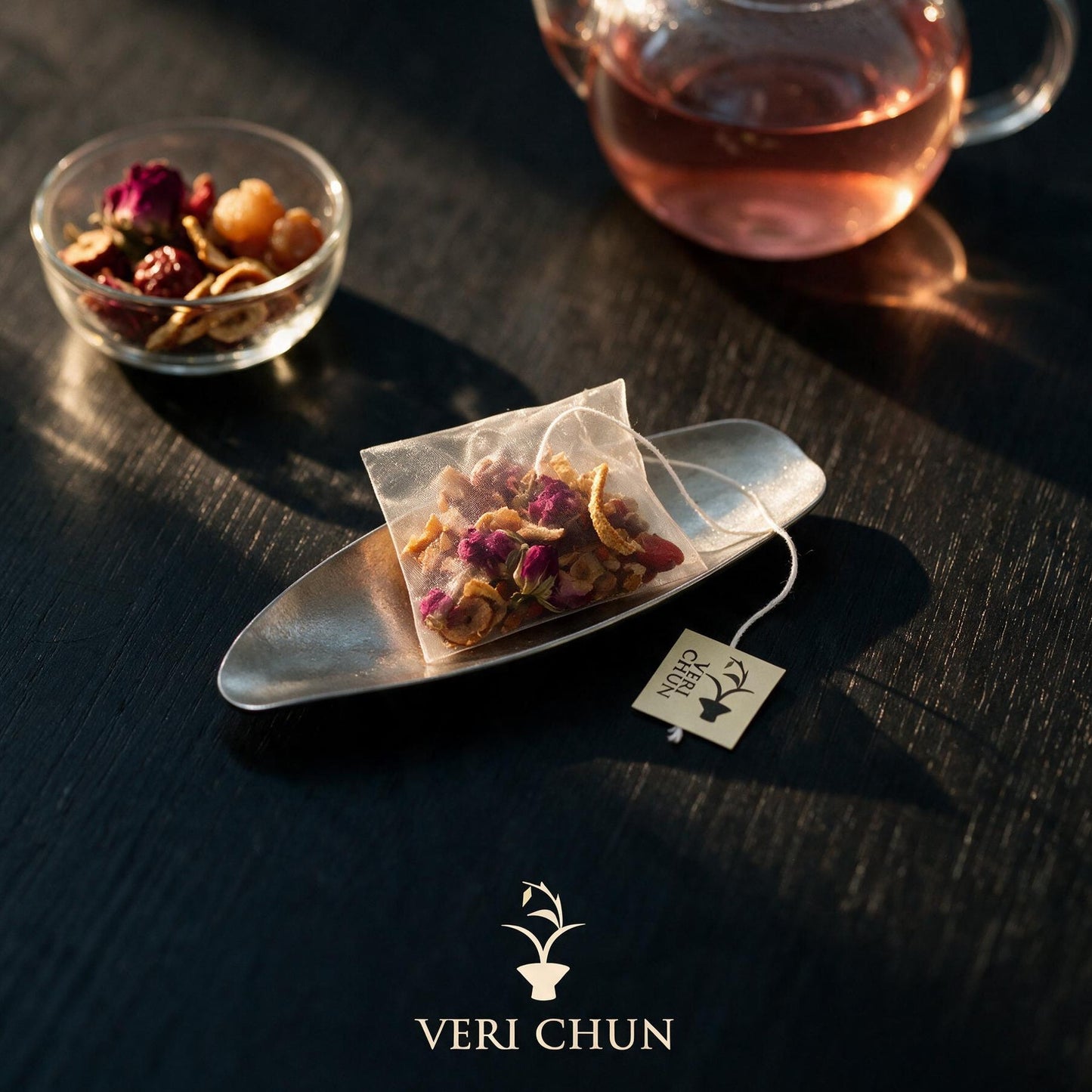
A few flowers unfold in hot water. Red berries soften, citrus peel releases its fragrance, and the color of the cup slowly begins to change.
Chinese herbal tea can be remarkably simple, yet it carries a long cultural memory. For generations, botanical ingredients have appeared not only in traditional practices, but also in family kitchens, seasonal recipes and the small routines of everyday life.
If you are discovering Chinese herbal tea for the first time, you may have questions. Is it the same as green tea? Does it contain caffeine? How does it taste? And where should you begin?
This guide explores Chinese herbal tea through the VERI CHUN perspective: culturally rooted, sensory by nature and designed for the life you are already living.
What Is Chinese Herbal Tea?
Chinese herbal tea is an infusion made by steeping or simmering botanical ingredients such as flowers, fruits, seeds, leaves, roots and citrus peel in water.
The English name can be slightly confusing because many herbal teas do not contain conventional tea leaves. Green, black, white, oolong and pu-erh teas all come from the Camellia sinensis plant. An infusion made only with chrysanthemum, goji berry, jujube or other botanicals is technically an herbal infusion or tisane.
In everyday language, however, “Chinese herbal tea” is commonly used for a wide range of drinks inspired by Chinese food-and-herb traditions. These may include:
-
Simple flower or fruit infusions
-
Botanical blends made with several complementary ingredients
-
Traditional regional drinks such as liang cha
-
Contemporary caffeine-free blends created for everyday enjoyment
At VERI CHUN, we often use the term Chinese botanical tea. It expresses what is in the cup while keeping the experience open, approachable and grounded in flavor—not medical promises.
More Than Tea: Understanding Yangsheng
To understand the place of herbal tea in Chinese culture, it helps to understand the idea of yangsheng—养生.
Yangsheng can be translated as “nurturing life.” It is a long view of care expressed through the small decisions we make every day: how we eat, drink, rest and move through the world.
It is not necessarily a dramatic intervention or a perfect routine. It can be as simple as preparing something warm, stepping away from a screen or allowing yourself a few quiet minutes between one part of the day and the next.
This is the idea at the heart of VERI CHUN:
养生,不必等以后。从这一盏开始。
Wellness doesn’t have to wait. Begin with this cup.
Why VERI CHUN Was Created
VERI CHUN began with the life we were living.
After years in fast-paced corporate environments, long days had become late nights. Takeaway meals, sugary drinks and work-related social drinking were ordinary parts of the week. Caring for ourselves mattered, but it was repeatedly postponed until “later.”
We kept returning to one question:
Why should yangsheng feel like something reserved for another stage of life?
We wanted to bring the practice into the present—not by recreating a traditional herbal shop, but by giving familiar Chinese botanical ingredients a new expression.
That meant approachable flavors, clear ingredient stories and contemporary visual design. It also meant making the ritual genuinely convenient: each VERI CHUN box contains eight individually wrapped tea bags that are easy to store, carry and brew at home, at work or wherever the day takes you.
Chinese Herbal Tea vs. Traditional Tea
The most important difference is the source of the ingredients.
Traditional tea is made from the leaves of the Camellia sinensis plant. This includes:
-
Green tea
-
Black tea
-
White tea
-
Oolong tea
-
Yellow tea
-
Pu-erh and other dark teas
Because the tea plant naturally contains caffeine, these drinks are generally caffeinated, although the amount varies.
Chinese herbal tea can be made entirely from botanical ingredients other than conventional tea leaves. Depending on the blend, it might contain flowers, fruits, roots, seeds or aromatic peels.
The five VERI CHUN botanical tea blends do not contain green or black tea leaves and are naturally caffeine-free.
Not every product described as “herbal tea” is caffeine-free, however. Some brands combine botanicals with green, black or oolong tea, so it is always worth reading the ingredient list.
What Does Chinese Herbal Tea Taste Like?
There is no single Chinese herbal tea flavor.
One blend may be soft and floral. Another might be fruity and tart, fresh and minty, or earthy with a gently bittersweet finish. The flavor depends on the ingredients, their proportions and how the tea is brewed.
Here are some common flavor families:
Floral
Rose and chrysanthemum create delicate aromas and a graceful, light-bodied cup. Floral ingredients can feel expressive without being heavily perfumed when balanced with fruit, leaves or citrus peel.
Fruity
Goji berry, jujube, longan, hawthorn, mulberry and dark plum can bring natural sweetness, brightness or tartness. Some create a rounded, comforting flavor; others give the cup a more vivid personality.
Fresh and Leafy
Mulberry leaf, lotus leaf and mint create clean botanical notes. Mint adds an especially crisp finish that can be enjoyed warm or chilled.
Earthy and Rooted
Ingredients such as ginseng and polygonatum offer deeper, more grounded flavors. Fruit ingredients are often added to soften and round out their distinctive character.
Citrusy
Tangerine peel contributes fragrance and a pleasantly bright, lightly bitter finish. It can lift richer fruit and root-based blends without making the cup taste sharply acidic.
Five VERI CHUN Blends, Five Different Expressions
Rather than telling you what your body should need, VERI CHUN invites you to follow your curiosity and choose the cup that feels right for the moment.
Yue Rong: A Gentle Floral Pause
Yue Rong brings together double-petaled red rose, longan, tangerine peel, jujube and goji berry.
Rose opens with a delicate floral aroma. Longan and jujube create mellow fruit sweetness, while tangerine peel gives the finish a gentle citrus lift.
Taste: Soft rose, honeyed longan, warm jujube and light citrus
Your moment: A slow morning, afternoon reset or evening ritual
Qing Ping: A Quiet Golden Cup
Qing Ping combines goji berry, white chrysanthemum, cassia seed and lotus leaf.
White chrysanthemum gives the infusion its golden color and clean floral aroma. Goji berry brings subtle sweetness, while cassia seed and lotus leaf create a soft, grounded finish.
Taste: Golden floral notes, subtle goji sweetness and a gentle herbal finish
Your moment: A screen break or a few quiet minutes between meetings
Fu Feng: Bright and Fruit-Forward
Fu Feng is made with cassia seed, hawthorn, tangerine peel, dandelion, dark plum and licorice root.
Hawthorn brings a lively tartness, while dark plum adds deeper fruit notes. Citrus peel brightens the blend, and its botanical base leaves a rounded finish.
Taste: Tangy hawthorn, mellow dark plum, bright citrus and clean herbs
Your moment: A flavorful pause after lunch or dinner
Zhi Lü: A Fresh Beginning
Zhi Lü pairs mulberry leaf with chrysanthemum, peppermint and tangerine peel.
Mulberry leaf creates a soft green foundation, chrysanthemum adds light floral depth and peppermint leaves a fresh, cooling impression.
Taste: Cooling mint, clear leafy notes, soft chrysanthemum and citrus
Your moment: The beginning of a busy morning or a midday reset
Yi Yuan: Warm and Grounded
Yi Yuan combines cultivated ginseng, mulberry fruit, polygonatum rhizome, jujube and goji berry.
Ginseng and polygonatum give the cup a warm, earthy character. Mulberry, jujube and goji berry soften the roots with gentle fruit sweetness.
Taste: Mellow roots, soft berry sweetness, warm jujube and a smooth amber finish
Your moment: A cool morning, demanding afternoon or unhurried pause
Is Chinese Herbal Tea Good for You?
Chinese botanical ingredients have long histories in food culture and traditional practices. However, tradition should not be confused with a promise that one drink can diagnose, prevent or treat a medical condition.
VERI CHUN does not believe that one cup can transform a life.
Instead, we believe that small, thoughtful rituals can help us meet the day with greater attention. The value of the cup can also be found in the experience itself: choosing a moment, noticing the aroma, putting down the screen and returning to something simple.
Not a quick fix. A practice.
How to Brew VERI CHUN Botanical Tea
There is no need for complicated tea equipment. Your favorite mug or a heat-safe glass is enough.
The VERI CHUN Tea Ritual
-
Choose your moment.
Before the day begins, between meetings or as the evening settles—make space where you can. -
Open one tea bag.
Each VERI CHUN blend is individually wrapped for freshness and an effortless daily routine. -
Add 350 ml of water.
Heat the water to approximately 85°C or 185°F and pour it over the tea bag. -
Steep for three minutes.
Adjust the strength according to your taste. Root-based or fruit-forward blends may become fuller when left a little longer. -
Pause and notice.
Let the color, aroma and flavor unfold. Put the screen down, even if only for a few minutes.
You can enjoy the tea warm, pour it over ice or refrigerate it after brewing and serve it chilled.
There is no perfect way to pause. The ritual is not about doing everything correctly; it is about returning to yourself, one small moment at a time.
Can Chinese Herbal Tea Be Enjoyed Cold?
Yes. Floral, fruity and mint-forward botanical teas can be especially refreshing when served chilled.
Prepare the tea as directed, allow it to cool and pour it over ice. If you prefer a stronger iced drink, use slightly less water when brewing.
Yue Rong becomes a light floral refresher, Fu Feng keeps its bright fruit character, and the mint and citrus notes of Zhi Lü feel especially crisp when chilled.
Store brewed tea in a covered container in the refrigerator and enjoy it while fresh.
How to Choose Your First Chinese Herbal Tea
Begin with flavor rather than complicated traditional terminology.
Ask yourself:
-
Do I prefer floral, fruity, fresh or earthy flavors?
-
Do I enjoy natural sweetness or a brighter tart finish?
-
Am I looking for a warm cup or something to serve over ice?
-
At what point in my day would I most enjoy a short pause?
If you love floral flavors, begin with Yue Rong or Qing Ping. Choose Fu Feng if you prefer something tart and fruit-forward. Zhi Lü is a natural starting point for mint lovers, while Yi Yuan suits those who enjoy a deeper, earthy cup.
There is no universally “best” blend. The right tea is the one you enjoy enough to return to.
A Sensory Ritual Beyond the Cup
At VERI CHUN, aroma, color, flavor and visual design are not decorations added after the tea is made. They are essential parts of the experience.
Each of our five tea blends is paired with a corresponding scented card. A complimentary matching card is included with every box, extending the sensory world of the blend beyond taste.
The intention is not to make your routine more elaborate. It is to offer another way to pause and notice—to experience the personality of each blend through both flavor and scent.
A Note on Botanical Ingredients
Botanical ingredients should be enjoyed thoughtfully. Please read the full ingredient list and any product-specific advisory before brewing, particularly if you have food or botanical allergies.
Some herbs may not be suitable for everyone and may interact with medications. Speak with a qualified healthcare professional if you take medication, have an existing health condition, are preparing for surgery, or are pregnant or breastfeeding.
Yi Yuan, which contains cultivated ginseng, is not suitable for infants, young children, pregnant women or breastfeeding women.
Chinese herbal tea is intended to be enjoyed as a beverage and everyday ritual. It should not replace professional medical advice, diagnosis or treatment.
Begin With This Cup
Chinese herbal tea does not need to feel old-fashioned, medicinal or difficult to understand.
It can be contemporary. It can be beautifully designed. It can fit beside your laptop, travel in your bag or wait quietly in the kitchen for the evening to settle.
Most importantly, it can begin now.
Choose a blend. Add water. Notice the aroma and let the ingredients slowly reveal themselves. You do not need to change your entire life before you begin caring for it.
养生,不必等以后。从这一盏开始。
Wellness doesn’t have to wait. Begin with this cup.
Explore all five VERI CHUN botanical tea blends and find the expression that feels right for your moment.
Frequently Asked Questions
Is Chinese herbal tea real tea?
Some Chinese herbal teas contain conventional tea leaves, but many are botanical infusions made from flowers, fruits, seeds, leaves and roots. The five VERI CHUN blends do not contain Camellia sinensis tea leaves.
Does Chinese herbal tea contain caffeine?
It depends on the ingredients. Blends containing green, black, white, oolong or pu-erh tea generally contain caffeine. All five VERI CHUN botanical tea blends are naturally caffeine-free.
What is yangsheng?
Yangsheng, written 养生 in Chinese, means “nurturing life.” It describes a long-term practice of care through everyday habits such as eating, drinking, resting and moving with greater attention.
What is the best Chinese herbal tea for beginners?
Choose according to flavor. Yue Rong is softly floral and fruity, Qing Ping is light and gentle, Fu Feng is tart, Zhi Lü is fresh and minty, and Yi Yuan is warm and earthy.
Can I drink VERI CHUN tea every day?
VERI CHUN blends are designed as approachable daily rituals, but suitability depends on the ingredients and the individual. Always review the ingredient list and product advisory, especially if you have allergies, take medication or have particular health considerations.
How many tea bags come in each box?
Each VERI CHUN box contains eight individually wrapped tea bags and includes a complimentary matching scented card.