

Chinese Cooling Herbal Tea: What Cooling Means
Cooling herbal tea, or liang cha (凉茶), can be served hot. “Cooling” is a traditional Chinese description of botanicals, independent of serving temperature, and the name does not make the drink a medical treatment. If Chinese botanical drinks are new to you, start with ingredients and flavors you enjoy rather than trying to decide what your body “needs.”
Hong Kong’s herbal tea tradition is shown in this video:
What “cooling” means in liang cha
Liang cha translates as “cooling tea.” The term belongs to the food traditions of southern China, particularly Guangdong. There, “heat” and “cooling” are ways of describing foods and botanicals rather than thermometer readings or promises about what a drink will do.
The word “tea” does not guarantee tea leaves from Camellia sinensis. People also use it for drinks brewed from flowers, leaves, roots or fruit. The name alone will not tell you which plants are in your cup. For a broader introduction, see what Chinese herbal tea is.
Traditional cooling teas vary: some taste bitter, while others have floral or fruit-tinged notes. The category does not include every Chinese herbal infusion. When choosing a drink, look at its ingredients and expected taste rather than relying on a broad label.
Can cooling herbal tea be served hot?
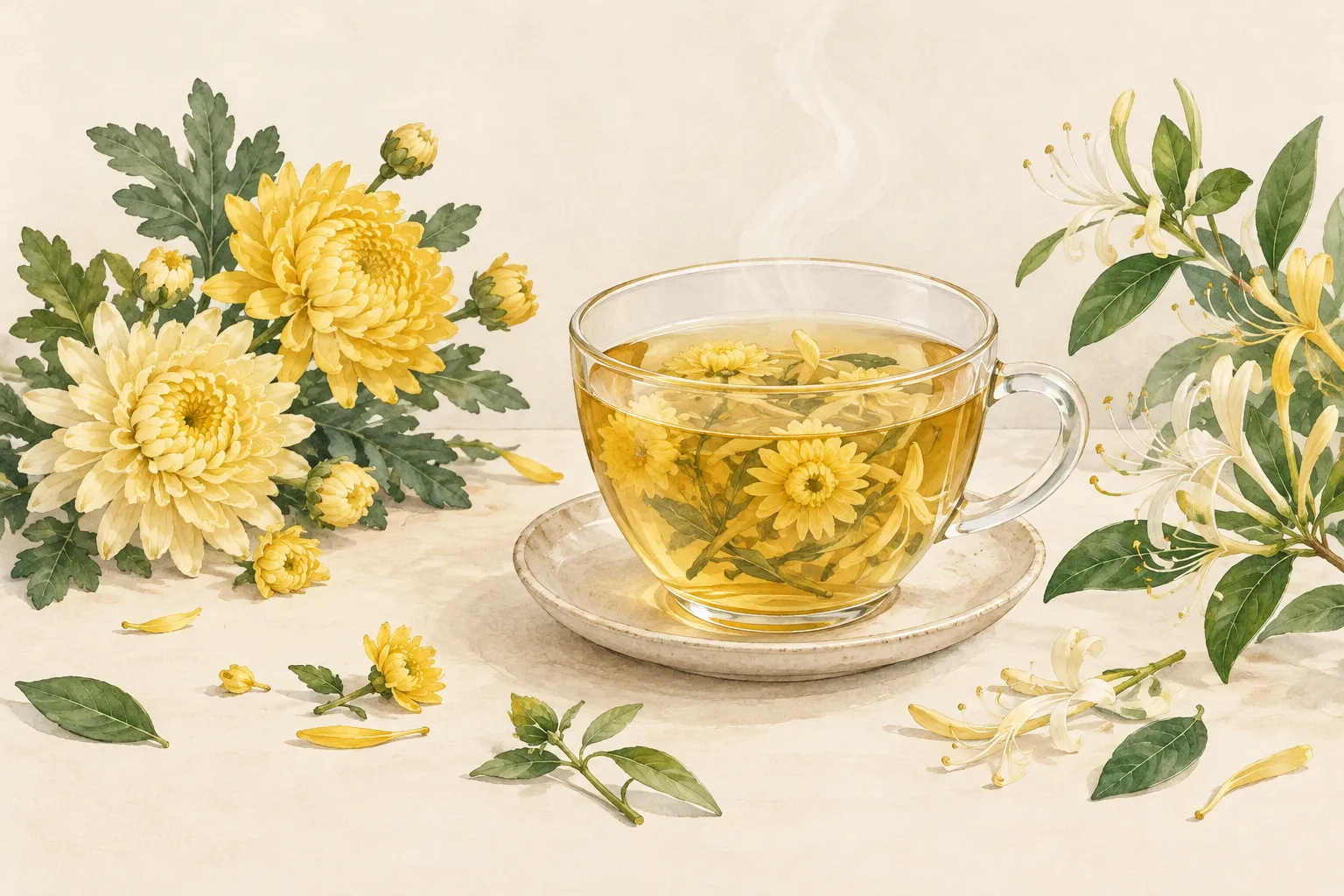
Yes. You can infuse or simmer the herbs in hot water and serve the drink warm. Chilling it later changes the serving temperature, not the meaning of liang cha. Mint can leave a cool feeling in your mouth, but that sensation is separate from the traditional label.
“This is liangcha, literally ‘cooling tea’ in Chinese. Despite the name, the drink is often served piping hot.” - China Daily, via the Guangdong Foreign Affairs Office
A warm cup still fits the name. By the same token, ice alone cannot make an infusion liang cha; the ingredients and cultural context count.
Which botanicals appear in cooling herbal tea?
Chrysanthemum and honeysuckle appear in traditional cooling drinks. Some regional preparations use frangipani flowers too. Recipes vary, and a familiar plant on a label cannot tell you whether the blend follows a particular traditional formula.
Chrysanthemum may turn up in a gentle floral blend; peppermint gives a crisp mouthfeel. Neither ingredient on its own identifies a tea as liang cha. A flower-led cup will taste different from a mint-forward one or a tart plum drink, even if each is sold as herbal tea.
Explore ingredients by flavor, not by a “cooling” label
VERI CHUN makes Chinese botanical infusions for everyday tea rituals. Its five blends pair familiar ingredients in different flavor profiles; none is identified as a traditional liang cha formula. The store describes all five as naturally caffeine-free; each comes in individually wrapped sachets.
Blend |
Listed botanicals |
Flavor direction |
|---|---|---|
Yue Rong |
Double-petaled red rose, longan, tangerine peel, jujube (red date), goji berry |
Soft rose, mellow fruit, light citrus |
Zhi Lü |
Mulberry leaf, chrysanthemum, peppermint, tangerine peel |
Crisp mint, light florals, green finish |
Qing Ping |
Goji berry, white chrysanthemum, cassia seed, lotus leaf |
Light florals, subtle fruit sweetness, toasted-herbal finish |
Fu Feng |
Cassia seed, hawthorn, tangerine peel, dandelion, dark plum (wu mei), licorice root |
Tart, dark-fruited, gently smoky |
Yi Yuan |
Cultivated ginseng (5 years or younger), mulberry fruit, polygonatum rhizome (huang jing), jujube (red date), goji berry |
Mellow, lightly earthy, gently fruity |
If rose and fruit appeal to you, start with Yue Rong; for a minty cup, choose Zhi Lü. Qing Ping brings light florals and a toasted-herbal finish, Fu Feng leans into tart dark fruit, and Yi Yuan is more earthy. These are flavor descriptions rather than recommendations based on symptoms or traditional classifications. The Yi Yuan product page says it is not suitable for infants or young children, or for pregnant or breastfeeding women. For individual suitability questions, use that advisory and ask a qualified professional.
Brew the cup, then decide what you like
For each of its five teas, VERI CHUN instructs you to use one sachet in 350 ml (about 12 US fl oz) of water at 85°C / 185°F, and steep for 3 minutes. This is the brand’s method for these blends, not a universal method for Chinese cooling tea. The cup begins warm, whatever the traditional label says about “cooling.”
The verdict is straightforward: liang cha describes a tradition, while serving temperature tells you how hot the cup is. For an everyday infusion, choose by ingredients and flavor. VERI CHUN’s Herbal Tea collection offers five clearly listed starting points without asking you to diagnose yourself or assume any blend is a traditional cooling formula.


