

Does Herbal Tea Have Caffeine?
Most herbal tea is naturally caffeine-free. The exceptions matter: yerba mate and guayusa contain caffeine, and some herbal blends include green, black, white or oolong tea. Read the full ingredient list before choosing a caffeine-free cup.
Does herbal tea contain caffeine?
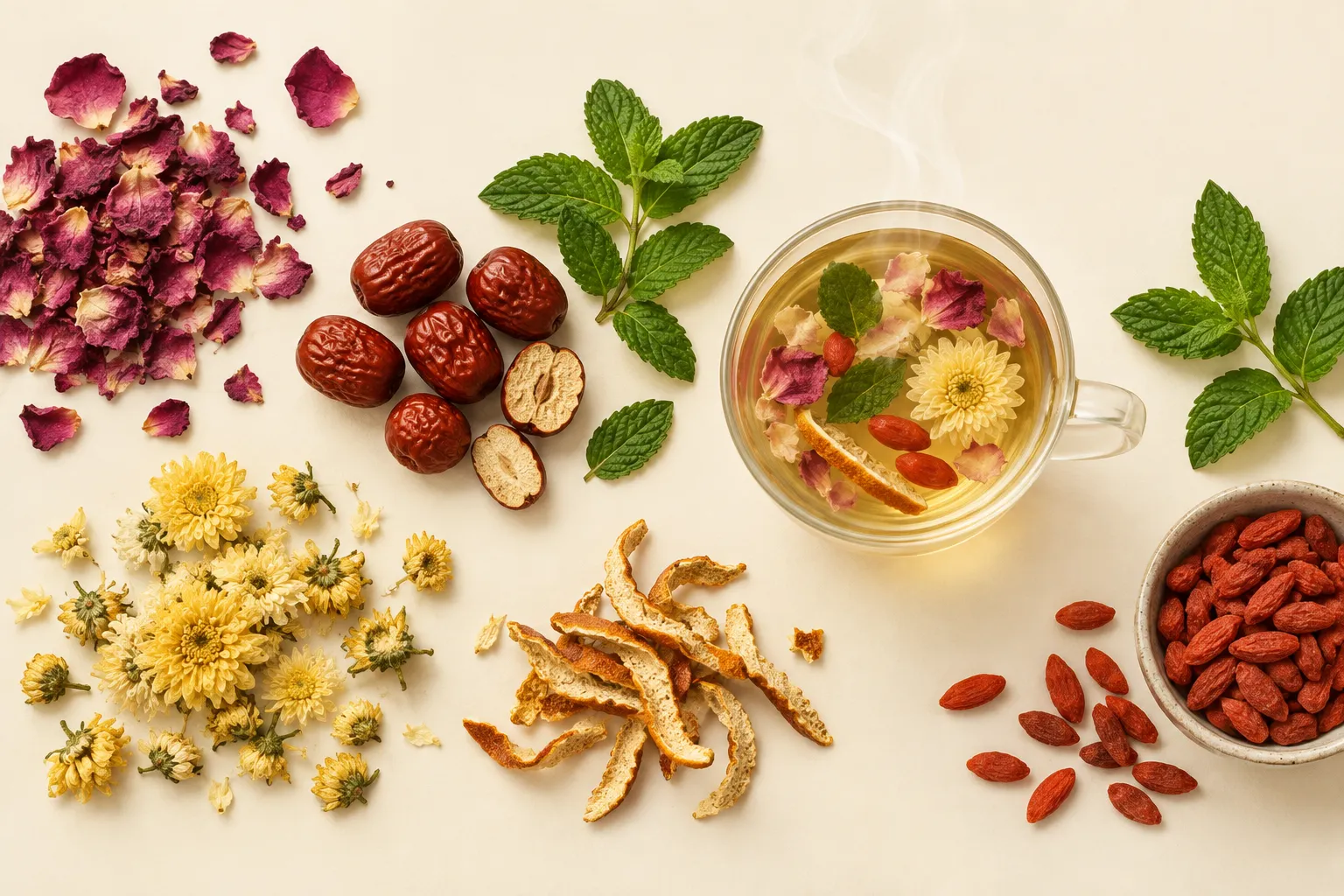
Usually, no. Shops use herbal tea for infusions of flowers, leaves, fruits, roots or seeds. These differ from tea made with leaves of the tea plant, Camellia sinensis. “Tisane” is another name for a herbal infusion. Steeping rose and jujube like tea does not add caffeine to the cup.
The definition has exceptions. Some plants used in herbal infusions contain caffeine, and some blends combine botanicals with tea leaves. The ingredients are more useful than the front-of-box name.
Herbal tea caffeine content varies by ingredients, so no single number applies to every blend. An infusion of peppermint or chamomile is different from one containing yerba mate. “Herbal” tells you little about the caffeine in a mixed product.
When can a herbal blend contain caffeine?
Two notable exceptions are yerba mate and guayusa. Both are plants used for infusions, and both contain caffeine. Adding fruit or other herbs does not remove it.
Also look for green tea, black tea, white tea or oolong tea in a mixed blend. Each comes from Camellia sinensis. “Mint tea” could mean peppermint alone or green tea flavored with mint; the ingredient list settles it.
An ingredients panel may name the tea plant as Camellia sinensis or list caffeine-containing extracts. For a caffeine-free choice, look for a complete ingredient list and a clear caffeine-free statement.
Herbal tea vs. decaf tea
“Naturally caffeine-free” describes an infusion made without caffeine-containing ingredients. Decaf tea starts with Camellia sinensis leaves and undergoes a process that removes most of their caffeine. Some caffeine can remain.
"It has less caffeine than regular tea, but still contains some." - U.S. Food and Drug Administration
Label |
What it tells you |
What to do |
|---|---|---|
Herbal infusion with no caffeinated ingredients |
Its listed plants are not sources of caffeine |
Read the complete ingredient list |
Herbal blend with mate, guayusa or tea leaves |
The blend can contain caffeine |
Do not assume “herbal” means caffeine-free |
Decaffeinated tea |
Most caffeine has been removed from tea leaves |
Do not treat “decaf” as the same as caffeine-free |
A caffeine-free botanical blend and decaf black tea may both taste mild, but their labels mean different things.
How to read a herbal tea ingredient list
Before buying a box, give the ingredients a quick read:
Scan the full list for yerba mate, guayusa, green tea, black tea, white tea, oolong tea, Camellia sinensis and added caffeine-containing extracts.
Look for a caffeine-free statement alongside the ingredients. “Herbal,” “fruit” and “floral” describe style or flavor; those words alone cannot establish caffeine content.
Make sure you are looking at a tea product. A botanical fragrance card’s scent description is not an edible ingredient list, and the card does not belong in a cup.
“Tea blend” alone gives you too little information to judge caffeine content. A fully listed blend makes the choice easier.
Five caffeine-free botanical blends, compared by flavor
VERI CHUN describes all five of its current herbal tea blends as naturally caffeine-free and lists the ingredients for each one. They come in individually wrapped sachets. For more about the plants themselves, see the brand’s ingredient notes.
Blend |
Listed ingredients |
Flavor direction |
|---|---|---|
Yue Rong |
Double-petaled Red Rose, Longan, Tangerine Peel, Jujube (Red Date), Goji Berry |
Soft rose, mellow fruit, light citrus |
Zhi Lü |
Mulberry Leaf, Chrysanthemum, Peppermint, Tangerine Peel |
Crisp mint, light florals, green finish |
Fu Feng |
Cassia Seed, Hawthorn, Tangerine Peel, Dandelion, Dark Plum (Wu Mei), Licorice Root |
Tart, dark-fruited, gently smoky |
Qing Ping |
Goji Berry, White Chrysanthemum, Cassia Seed, Lotus Leaf |
Light florals, subtle fruit sweetness, toasted-herbal finish |
Yi Yuan |
Cultivated Ginseng (5 years or younger), Mulberry Fruit, Polygonatum Rhizome (Huang Jing), Jujube (Red Date), Goji Berry |
Mellow, lightly earthy, gently fruity |
If you like rose and fruit, start with Yue Rong. Zhi Lü has a crisper mint profile; Fu Feng leans tart and dark-fruited. Qing Ping offers light florals, while Yi Yuan is the earthy-fruity option. Yi Yuan’s product page says it is not suitable for infants or young children, pregnant women, or breastfeeding women. For personal suitability questions, consult its product advisory and a qualified professional.
VERI CHUN’s botanical-inspired scented cards are for fragrance only. Do not eat or brew them. Buying a card alone does not include tea, and the scent name is not a tea ingredient list.
Brewing a cup
VERI CHUN’s directions for all five blends are to steep one sachet in 350 ml (about 12 US fl oz) of water at 85°C / 185°F for 3 minutes. Other herbal infusions may call for different brewing.
Once you have found a blend with the caffeine information you need, choose by flavor: rose, mint, tart fruit, light florals or an earthier cup.
The bottom line
Most herbal infusions are naturally caffeine-free. Yerba mate, guayusa and blends containing actual tea leaves are the important exceptions, while decaf tea can still retain caffeine. If you want a clearly listed botanical cup with a flavor you can choose for yourself, explore VERI CHUN’s Herbal Tea collection.


